
The New Logic of Customer Service: How AI Connects Efficiency and Customer Experience
For years, the challenge of automating customer service has been tackled with chatbots and “dumb” automation. In principle, they worked — they reduced the number of incoming cases and lowered costs. But customers hated them.
Customers often found themselves stuck in a loop: the bot didn’t understand the question, getting through to a human took forever, and the issue remained unresolved. Efficiency and customer satisfaction became two sides of the same coin — you could choose one, but not both.
AI-assisted customer service has the potential to change this equation. For the first time, it is possible to serve customers quickly, without queues, and actually resolve their issues instead of leading them into dead ends. When built correctly, efficiency and customer experience are no longer opposing goals.
However, this shift does not happen automatically. And in the midst of transformation, organizations tend to fall into familiar pitfalls:
Technology first, business second
Data is fragmented and not truly usable for AI
Expert work is not redesigned
When these go wrong, the result is not a digital colleague — but an expensive FAQ page.
Business Logic First, Technology Follows
This may sound obvious, but in practice development too often starts with acquiring a chatbot or launching a pilot, and only afterward trying to justify it from a business perspective. The result is technology that doesn’t create meaningful enough impact — or delivers only a fraction of its potential value.
Customer service development should always start with a clear driver: increasing revenue, improving customer experience, or reducing costs. From these, concrete objectives are derived — shorter handling times, higher self-service rates, more consistent service quality. Only then should the question be asked: what technology is needed, and where in the process?
Successful development progresses on two fronts simultaneously. On one hand, there must be a clear long-term vision: what kind of customer service experience is being built, how it is managed across channels, what role automation plays, and how people’s work and operating models will evolve.
On the other hand, there must be practical, value-driven development—focused experiments, pilots, and continuous learning. What does the target state feel like for customers and experts in everyday work? Where do service journeys break? Where does uncertainty arise? And where can AI genuinely help—not just speed things up?
Vision and agile development reinforce each other: one provides direction, the other maintains momentum.
AI Remains Superficial When Data Is Fragmented
The pain points of customer service are well known. A large share of inquiries are simple, yet handling them still consumes expert time because the required information is scattered across multiple systems. Customers may switch channels, forcing the process to restart. In the worst cases, they contact multiple channels simultaneously, hoping to get an answer from at least one.
Traditional chatbots attempted to solve this with rule-based logic: if the customer says X, respond with Y. The problem was that customers don’t behave according to predefined rules. When situations deviated from the script, the bot failed. Often, the outcome was worse than a simple email queue.
Today’s language models work differently. They can interpret free-form text, process speech, analyze documents, and combine information from multiple sources. Most importantly, they can turn this into actionable recommendations—not just retrieve information, but shorten the distance from insight to action.
In practice, this means AI can combine a customer’s purchase history, previous interactions, delivery status, and relevant guidelines into a single view—and then suggest the next step to an expert, or even execute it automatically: approve a refund, offer a replacement product, prioritize the case. The expert’s role shifts from gathering information to validating decisions.
This is where technical architecture becomes critical. For AI to operate effectively, it needs access to the right data at the right time—customer data, order systems, product information, and internal guidelines. Without a functional integration layer and data infrastructure, AI produces generic responses.
And at that point, it is no longer a digital colleague—but an expensive FAQ page. This is one of the main reasons AI pilots fail: the technology works, but the data is inaccessible or too fragmented.
Expert Work Must Be Redesigned
Adopting AI is not just a technology initiative—it is a redesign of work. Yet this is often overlooked.
AI in customer service is not a threat to expert roles; it is an opportunity to reshape them. As routine inquiries move to automation, experts can focus on more complex cases, building customer relationships, and supporting sales. Service quality improves because simple cases are handled quickly and reliably, and experts no longer need to navigate multiple systems to find answers.
But when the nature of work changes, it must be actively redesigned. Where does the expert make decisions? How are exceptions handled? How do we ensure no one is left alone in uncertain situations?
When AI has access to the right data and context—customer information, guidelines, industry terminology—it becomes a true extension of the organization. It uses the correct product names, follows agreed processes, and communicates in line with the brand. The result is not “AI that responds,” but a digital colleague aligned with company practices.
Real-world examples support this shift. Maersk implemented AI to analyze free-form customer emails about shipment status. Previously, responses could take hours, as agents manually reviewed emails and searched across multiple systems. With AI, customers now receive answers almost instantly, and experts can focus on exceptions.
Stanley Black & Decker addressed fragmented information by unifying data into a single view and augmenting experts with AI. Instead of searching across folders and systems, employees now receive the right information directly—leading to clear productivity gains and strong business impact.
Octopus Energy integrated generative AI directly into its email system to respond to customer inquiries. According to the company, AI-generated responses achieved an 80% customer satisfaction rate—higher than the 65% achieved by human-written responses. The system can handle email volumes equivalent to the workload of hundreds of employees daily.
The Evolution Is Gradual — But the Direction Is Clear
The transformation of customer service does not happen overnight. Initially, everything flows through human agents. In the first phase, AI takes on part of the routine work and supports experts. In the next phase, most simple cases are handled automatically, while humans focus on complex or exceptional situations.
In the long term, the majority of volume may flow through AI—while customers still have access to human support when needed.
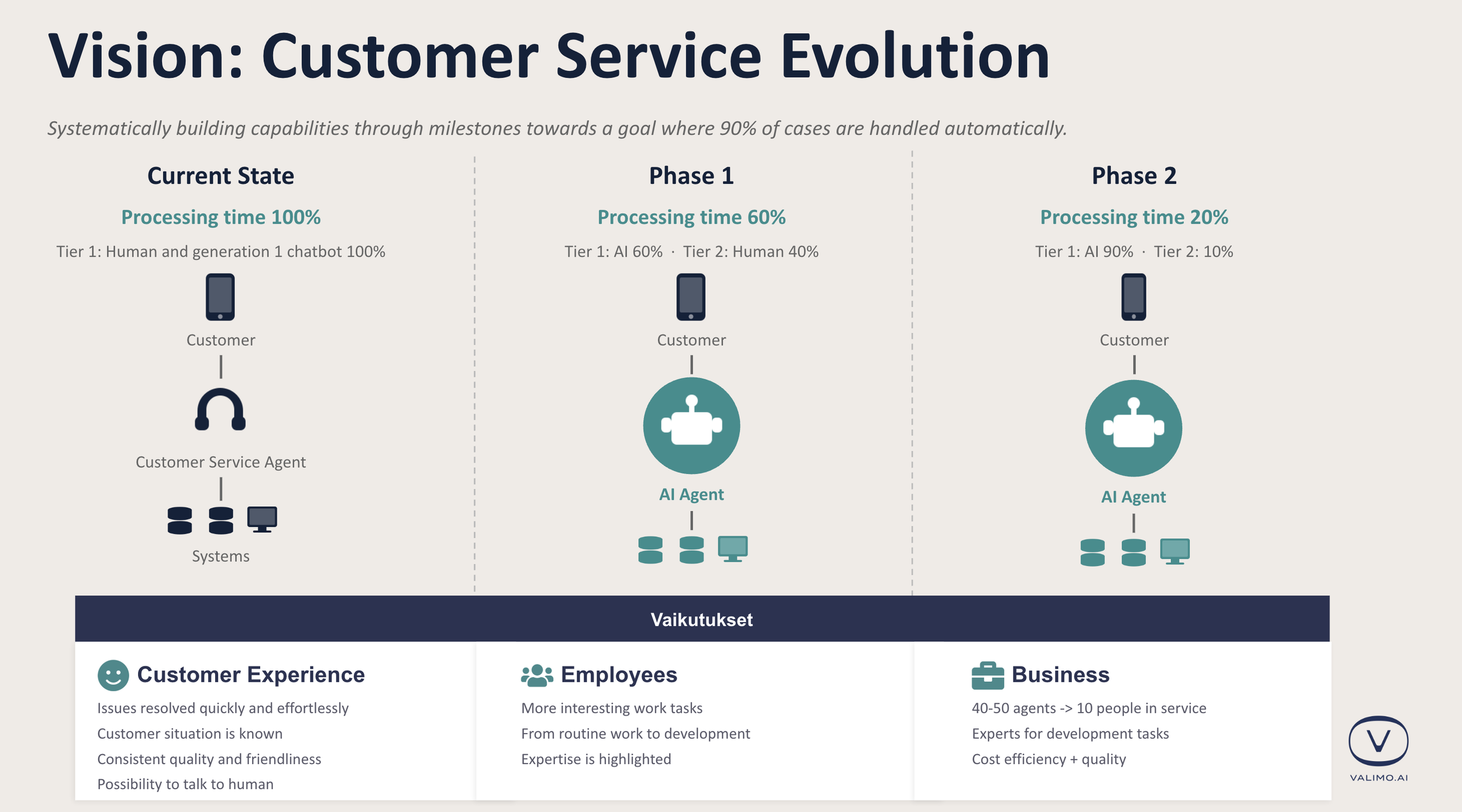
Each phase reshapes roles and ways of working. This is not just about increasing automation, but about continuously redesigning how work is done. At the same time, the role of customer service evolves—from a reactive support function to a proactive, value-generating capability that supports the business through speed, quality, and data.
Organizations that succeed in leveraging AI in customer service get three things right:
They start from business objectives
They build a solid data and integration foundation
They redesign expert work
Those that succeed with this combination turn customer service into a true competitive advantage.
* Sources
Maersk: https://www.maersk.com/news/articles/2023/03/14/the-ai-chatbot-chatgpt-is-a-game-changer , https://debales.ai/blog/maersk-ai-logistics-cost-savings-lessons
Stanley Black & Decker: https://business.adobe.com/customer-success-stories/stanley-black-decker-workfront-case-study.html, https://www.rockwellautomation.com/en-au/company/news/magazines/stanley-black-deckers-digital-transformation-journey-accelerates-innovation.html
Octopus Energy: https://sifted.eu/articles/octopus-energy-ceo-chatgpt-news
